Mowley Valley – delivering biodiversity gain and flood alleviation

Mowley Valley – delivering biodiversity gain and flood alleviation

Mowley Valley, Summer 2023

On an evening when heavy rain and flood warnings were very much on people’s mind, the team at Mowley Valley showed how this inspiring habitat restoration project can also deliver other important benefits - flood alleviation and improvements to water quality.

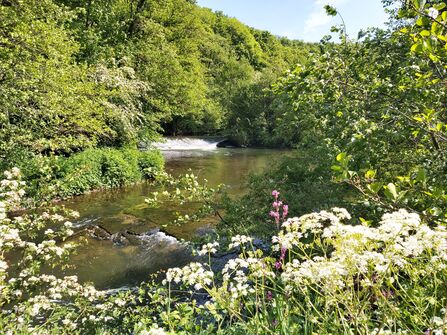
 Mowley Valley is situated between Titley and Staunton-on-Arrow in west Herefordshire, with the River Arrow flowing along its one and half mile length. When the river floods, the area of land covered by water increases from two acres to five. Slowing the speed at which water flows downstream is good news for villages such as Eardisland that can be cut off in times of heavy rain.

At the February meeting of the Weobley branch, Catherine Janson, project lead, and Sarah Cadwallader, Tony Norman and David Griffith gave us an update on how this 160-acre habitat restoration project was delivering many firsts for Herefordshire. 

Owner Edward Bulmer approached Catherine Janson in 2019 and the 4-person project team formed – each bringing their expertise and hard work to the project. Funded initially by the Environment Agency, the aim was to increase the range of habitats within the site, protect the soil and increase carbon capture, and provide resilience to flooding. These days the project is self-funded.

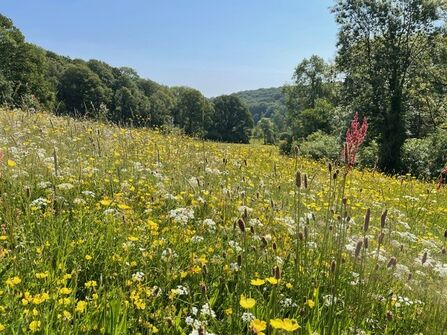
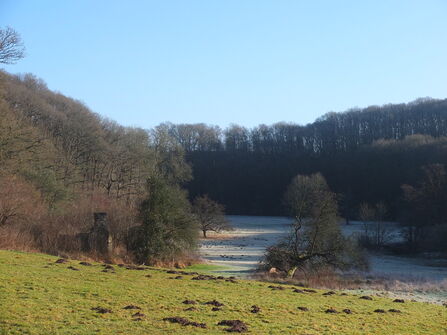
Mowley Valley comprises species-rich meadows with shrub and ancient woodland on the steep valley sides. The scrapes hold water providing habitat for dragonflies and amphibians. Margins beside the river have been left to thicken, the rushes and longer grass slowing the flow in times of flooding. 
There’s an astonishing diversity of wildflowers, some brought as seed from a nearby SSSI meadow belonging to Tony Norman. Notables include pignut, bird’s-foot trefoil, lady’s mantle, common spotted orchid, meadow saxifrage and lady’s smock exhibiting a rather beautiful double flower. The meadows along the valley floor are alive with butterflies and insects feeding on the nectar-rich wildflowers.

“The once common spreading bellflower has been lost from Herefordshire but we were lucky as Stuart Hedley persuaded the Millenium Seed Bank at Wakehurst Place to let us have seed and now spreading bellflower has a home in Mowley Valley,” said Catherine Janson.

Since the project team spoke to the Weobley branch three years ago, the number of identified moth species has increased from 400 to 600. Mowley Valley now has all three of the burnet moths including the five-spot burnet moth, thought to be extinct in Herefordshire with no records in the last 50 years. Butterflies abound, including the rare purple hairstreak, wall and wood white. For the first time in 2025, the Brown Argus has been seen, a rarity for Herefordshire.

The river is home to a family of otters, European eel, salmon parr and white-clawed crayfish. There are polecats, stoats and hares. Pied flycatchers are breeding summer visitors, along with, redstarts, blackcap and resident marsh tits. 

The 100 acres of ancient woodland are an important habitat for wildlife including rare bryophytes and the team are kept busy maintaining the sunny rides and glades. Sarah Cadwallader was excited to share that footprints have been seen in dormice tunnels placed at various locations in the woods.

In 2024, 25 acres of land was added, adjacent to and downstream from Mowley Valley. From observing where flood water flowed across the site and creating test beds, it was decided the best places to dig scrapes to hold back water when the river is in spate. It doesn’t take long for wildlife to exploit a new habitat, while the scrapes were being dug, ruddy darter dragonflies were seen laying eggs in the water! Common sandpiper, greenshank and kingfishers are now regular visitors. 

So what next for Mowley Valley? After an action-packed six years, the project is looking to take on an educational role inviting primary and secondary schools in the catchment area to experience a landscape full of life, inspiring the next generation to care about the natural world. Although the land is private with no public access, the team at Mowley Valley welcome interested groups for guided walks by arrangement. 

Email: catherine.janson16@gmail.com