

Maple leaves in Autumn
Queenswood's History
Queenswood in the early days
Queenswood Country Park and Arboretum has a fascinating history as its ownership and uses changed over the centuries.
Originally it was part of a vast oak woodland that stretched to the Welsh borders and beyond. The land was held by the Crown, then in the 17th century Kingswood as it was known became part of the Hampton Court Estate, which still borders the country park on the opposite side of the main road.
During the First World War, timber was required for the war effort and Queenswood was clear-felled. Once managed for the profitable timber and coppice products it produced, Queenswood was no longer economically viable and there was a danger the land would be sold off for holiday homes with no planning control to prevent this happening. This kick started the move to bring Queenswood into public ownership.
First, the land was purchased by the Campaign to Protect Rural England (CPRE) in 1934 following a public appeal. Then in 1935 the County Memorial Scheme was launched to provide a lasting memorial of the Silver Jubilee of King George V and, in agreement with CPRE, the land was handed over to Herefordshire County Council to be managed “as an open space for the enjoyment of the public for all time”.
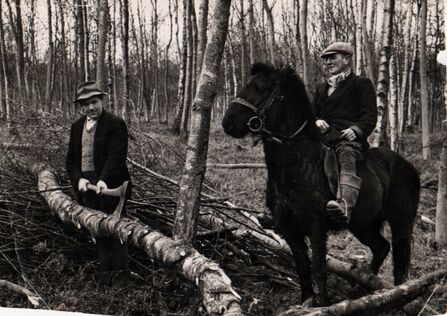
Mr Probert, on his horse, was the sole woodsman employed at Queenswood between 1959 and 1977.
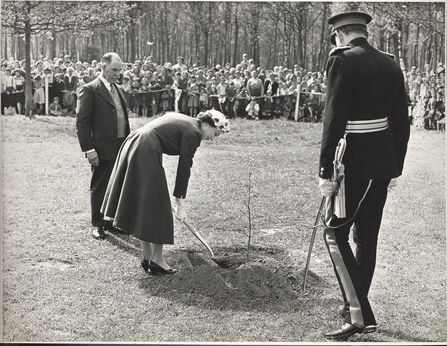
Queen Elizabeth II planting tree at Queenswood
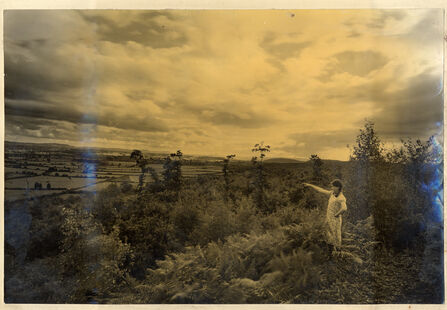
How Queenswood came to belong to the people of Herefordshire

Developing the arboretum
By the 1930’s the hilltop was covered with the regrowth of young trees and dense scrub. A management committee was established and the first ranger was employed to start opening up the rides and thin the trees so that the public could enjoy the site.
In 1945 Sir Richard Cotterell, a neighbouring landowner, became chairman of the management committee and looked at planting the woodland for amenity. When the cost of planting the whole 170 acres proved to be too great, it was decided to focus on the central 47 acres which is now the arboretum.
A public appeal was launched to mark the coronation of Queen Elizabeth II in 1953 and raise money to plant rare and beautiful trees in this central section of the woodland. It was at this point that Kingswood became Queenswood. After establishing the Coronation Fund, Sir Richard Cotterell went on to implement his vision of how the growing woodlands should be shaped and managed for future generations to enjoy.
Queenswood as we know it today would not exist without his drive and vision. Highlights include the majestic Redwood grove, Japanese maples that provide a double whammy of pink and white spring blossom and stunning autumn colours, and the Oak avenue comprising 32 different species.
A further public appeal in 1987 raised £150,000 and enabled major improvements to take place at the country park including the movement and re-erection of the timber framed buildings in the 1990’s that now house the visitor centre and gift shop, Woodland Café as well as Herefordshire Wildlife Trust’s office.
Looking back to Queenswood as a working wood
The present day woodland is the result of natural regeneration since the hillside was clear-felled during the First World War. Before this, records show that the woods were managed as coppice for at least two centuries and probably a lot longer. There would have been very few of the large trees which make up a typical woodland today - instead trees were regularly harvested whilst relatively small.
The archaeology at Queenswood provides evidence of the intensity of woodland working here in earlier times. Centuries-old saw pits and charcoal burning platforms can be found on the hillside as well as numerous ancient holloways (sunken tracks) used by horses to extract the timber and stone from the woodland.