
This year, more collaborations with landowners and organisations have enabled us to influence positive change on more of the county's landscape while projects on our own estate are showing how to create the essential habitats we need to see connected through our countryside and cityscapes.
Highlights of 2025: Nature Recovery
Planting wildflower plug plants, Lugg Meadow 2025 (c) HWT
A busy year for the Nature Recovery staff and volunteers, packed with acheivements
Restoring Herefordshire's Rivers
Through our Wye Adapt to Climate Change project, (funded by The National Lottery Community Fund Climate Action Fund,) we have been working with landowners to alter land management to make the land more nature-friendly and sustainable in the face of increasingly extreme weather events. This year, as well as providing advice, we have supported the implementation of practical actions including: tree planting, installing leaky dams to slow the flow of streams, hedgerow planting and management, fencing off watercourses from livestock, restoring meadows, creating ponds and scrapes.
We have also set up five new riverfly monitoring sites in collaboration with Friends of the River Wye in the west of Herefordshire and one new site in Mansel Lacy in the upper Yazor catchment. We have provided ongoing support for the Yazor Brook and Wellington Brook riverfly groups with funding, training, equipment and advice. By carrying out regular surveys for different species of river fly, the teams can better understand and report on water quality and river health, spot long-term declines and short-term pollution incidents.
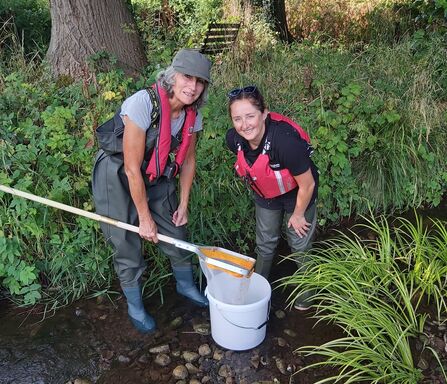
Riverfly Survey, Yazor Brook, Mansel Lacy 2025

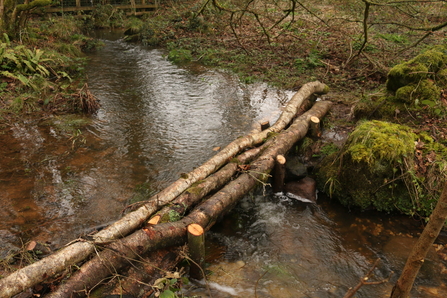
Example of a leaky dam
Restoring Bartonsham Meadows
Our project to restore a mosaic of habitats at Bartonsham Meadows in Hereford continued this year, funded by The National Lottery Heritage Fund.
In the areas that we are restoring to floodplain meadow, we now have a management regime in place with regular cutting and grazing. This has allowed us to spread wildflower seeds into areas where the weed species like docks and thistles have now reduced after two years of this management. Volunteers have also planted 150 plugs of sneezewort, great burnet, pepper saxifrage and narrow leaved water dropwort - characteristic species of floodplain meadows.
Other areas of the site are being left to regenerate into a mix of scrub and grassland. We have now fenced these areas to allow light grazing and protect from disturbance.
Staff and volunteers have planted the new orchard and it was kept alive through the summer drought by amazing volunteers.
Damsons, black poplars, and oaks were also donated by volunteers and planted close to the Green Street entrance.
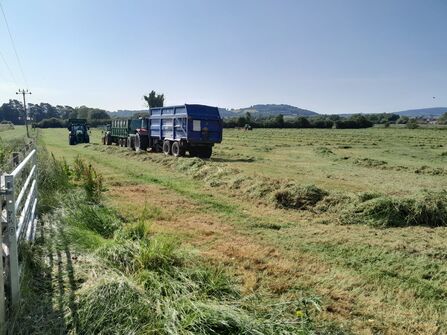
Cutting grass and vegetation, Bartonsham Meadow 2025
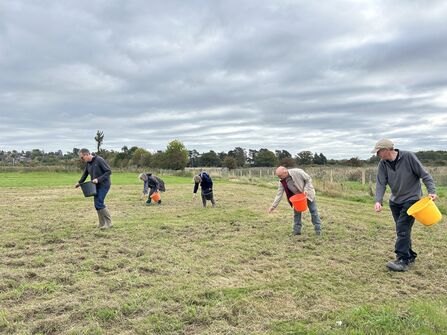
Seed sowing, Bartonsham Meadow 2025
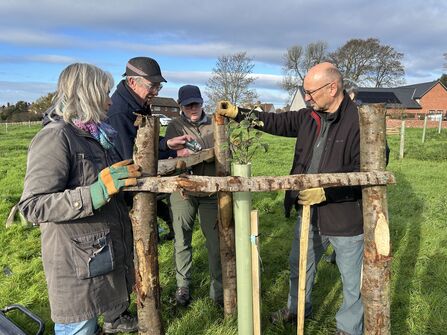
Installing tree guards, Bartonsham Meadow 2025
Bodenham Lake
The Bodenham Reedbed Project, funded by the National Highways Network for Nature programme was completed earlier this year. Two hectares of floodplain meadow have been restored and an additional hectare of reedbeds has been created around the eastern edge of the lake. Lakeside trees have been thinned and coppiced allowing more natural light into the lake edge habitats. Site infrastructure has also been improved with a repaired access track and signage.
We have also: run our annual toad patrols, bashed a lot of Himalayan balsam (an invasive non-native species), carried out bird surveys and monitored camera traps, pruned the orchards and watched ‘our’ osprey fishing.
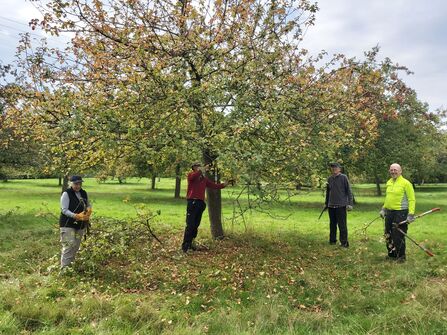
Volunteers pruning at Bodenham Lake orchard 2025

Osprey, Bodenham Lake, 2025 (c) Paul Lloyd
Local Wildlife Sites
The Local Wildlife Sites project is funded by Herefordshire Council and delivered by our Nature Recovery Officer, Toby Fountain.
The aim of the project is for Herefordshire’s best wildlife habitats to be mapped, understood, protected and well managed to support the ultimate goal of 30 by 30. Toby aims to survey at least 20 Local Wildlife Sites annually (old or new) and compile management reports for each, while also developing new criteria to better recognise and designate important sites.
This year:
- We developed new criteria for designating Local Wildlife Sites specific to butterflies and for traditional orchard habitat and mire/ heath habitats.
- Surveys and management reports were completed for 22 Local Wildlife Sites, with a combined area of 425ha. This includes 14 new sites (375ha). This will give these sites increased protection into the future and supports the owners to manage them most beneficially for wildlife. Several landowners are using Toby’s reports as a basis for higher tier applications, and other means of obtaining funding for management.
- Many positive relationships with landowners have been forged through this project, this year working in the west of Herefordshire in particular.
Lugg Meadows - species recovery
Our work at Lugg Meadows focused, this year, on restoring populations of two key species: narrow-leaved water-dropwort (Oenanthe silaifolia) and mousetail (Myosurus minimus). As well as directly planting thousands of small plug plants of these species into the meadow, we have also altered and improved aspects of the site management which will benefit a huge range of species. This includes completing the infrastructure that will allow the reserve to be grazed by cattle; opening historic drainage channels and improving the hay cutting regime. This project has been made possible by funding from Natural England through its flagship Species Recovery Programme.
We also worked with the local community group, Plantlife and Herefordshire CPRE to successfully campaign against a proposed huge development right on the edge of Lower Lugg Meadow that would have had terrible consequences for the meadow, the river and its wildlife.
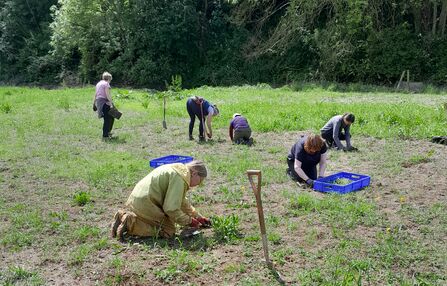
Planting wildflower plug plants, Lugg Meadow 2025 (c) HWT
Severn Treescapes
The Treescapes programme began in 2022 and is a partnership between the Herefordshire, Worcestershire and Gloucestershire Wildlife Trusts. It aimed to expand, connect, protect and improve a 60-mile corridor of enhanced tree cover from the Lower Wye to the Wyre Forest, assisting landowners to access funding for tree planting. We are now also working throughout the three counties with funding from the Environment Agency, this enables us to pay for the trees, stakes, guards, planting, and fencing, and gives the landowner money for tree maintenance.
This year a new part has been added to the project, it focusses on identifying and surveying veteran trees and traditional orchards for deadwood habitats which support key priority species such as the noble chafer beetle and lesser spotted woodpecker.
Earlier this year we planted 16 hectares of new woodland in Herefordshire and pipelined a further 85 hectares of woodland planting through other schemes. We are continuing to plan and plant new woodland sites throughout Herefordshire and have several in the late planning phases to be planted in the next couple of months.
We have begun this season’s planting with some replanting where there were failures due to the dry spring and summer and have been looking at ways to do some things differently. For example, we are ‘planting’ acorns with soil into the top of tree guards where the trees have died, and we are planting some cell grown trees instead of bareroot. We will carry out monitoring to see how successful these are with our changing weather patterns.
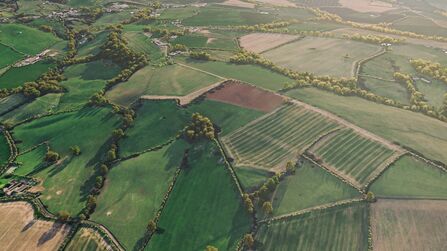
Bank Farm - before interventions
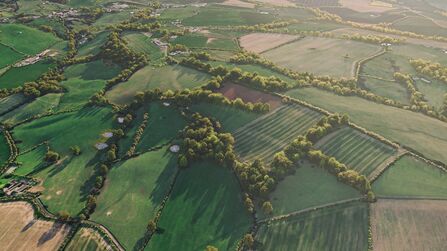
Bank Farm - how it will now look in the future following interventions
2026 - here we come!

All staff visit to Meadowlands, 2025
We will continue to deliver excellent results for nature through our existing projects:
Restoring Bartonsham Meadows: we will deliver a new regular Youth Rangers Club and increase our work with community groups, enabling more people to get involved and help nature thrive in the city.
Severn Treescapes:
- We will continue to help landowners access funding for tree planting.
- We are looking forward to planting up a minimum of a further 8 hectares of land with trees over the winter.
- We will deliver a series of Orchard workshops, training Orchard owners how to care for their trees
- We will train and support volunteers to help with our Orchard and Veteran Tree surveys
Local Wildlife Sites:
- The project will repeat in 2025-26, with the same main objectives: survey at least 20 LWS sites and create management plans for their future care.
- We will better connect landowners who own Local Wildlife Sites to share skills, knowledge and resources.
- We will focus on sites with scarce and priority habitats/species, especially those which are not designated.
- We will continue to develop new criteria for assessment and designation. In 2026 this is be for ponds and moths
We will develop and begin new projects to build on our work to restore our rivers and streams. These include:
- a project supporting landowners within the Lugg catchment to increase and improve habitats on their land which help to improve water quality and increase biodiversity.
- a project working with communities in North Herefordshire, providing training, skills and support for them to improve freshwater habitats in their local areas.
- a project in Hereford City to restore more of the city’s brooks and streams, create wildlife corridors along these waterways, and engage communities from across the city in celebrating and protecting these hidden treasures.
We will develop and begin a new landscape project in the Woolhope Dome.
We will develop a project focused on monitoring, understanding and restoring populations of lesser spotted woodpeckers in the county.

Yellowhammer ©Mark Hamblin/2020VISION
Support us to do even more in 2026!
Please donate today, if you are able, to ensure we can continue to achieve great thinks for nature in 2026.
While we are very grateful that we area awarded grants to fund some of our project work, much of our day to day activity, as well as the research and development of new projects, programmes and partnerships, relies on donations, membership subscriptions and legacies.